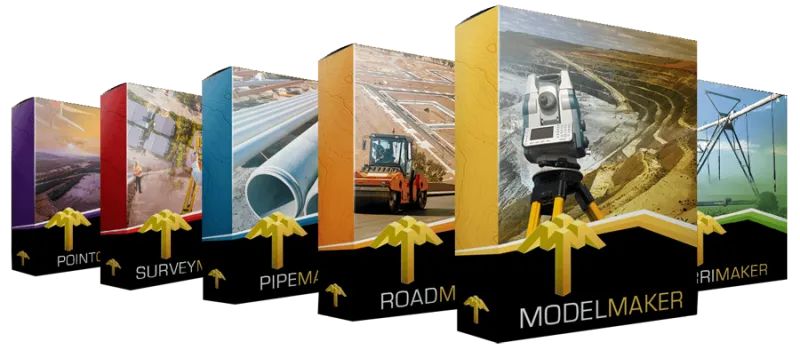
 Road Maker
Road Maker caters for the needs of design
professionals and contractors. Data can be extracted from a DTM (Digital
terrain Model) survey using MODEL MAKER and can be exported to ROAD
MAKER or data can be entered manually.
The vertical alignment and road cross-sectional profile is defined using
easy-to-use built-in functions. Bulk earthwork volumes can be calculated
between a ground cross-section group and the design profile or between
any two ground cross-section groups. Detailed volumes van also be
calculated for e.g. layers, topsoil etc. Final cross-section and
long-section drawings can be plotted directly to a plotter, plot file or
various CAD data exchange or ASCII formats.
Complete setting-out information can be obtained for setting out the
design on site, e.g. layer profiles and batter boards. The design
profile or ground cross-sections can be converted into DTM format for
further manipulation with MODEL MAKER.
ROAD MAKER MODULES
Why modules? - So that
each user can customize his own package
and thus saving cost by not having to
buy un necessary/unused software
functionality.
Module 1 -
SINGLE CROSS-SECTION
GROUP MANIPULATION
|
Required Modules: (3)
|
|
Using
this module multiple chainage cross-sections may be imported from various
file formats or entered manually. A long-section could be loaded or
extracted from the cross-sections. Only one section profile can be
viewed at any one time.
Module 2 -
MULTIPLE CROSS- AND
LONG-SECTIONS
|
Required Modules: 1
|
Up to 8 cross-section and
long-section profile groups may be loaded. Any one or all of these groups may
then be plotted. Earthworks volume calculations may be done between any
two groups. This module is also required with Module 3 if one would like
to balance the Cut and Fill Volumes over a length of road.
Module 3 -
SINGLE CARRIAGEWAY ROAD DESIGN
|
Required Modules: 1, (2)
|
This
module provides the user with user-friendly and very flexible road
design functions. The vertical alignment design may be done directly on
screen or it may be entered from external design results. It allows for
non-symmetrical vertical curves and the checking of design limits. The
cross-sectional profile is defined using the most advanced techniques in
manipulating individual components independent from others for example
:- road width and batter slope changes. An extensive verge design
function supplements the basic design profile. Variable drains, batter
parameters and topsoil stripping may be specified. Calculation results
include volume calculations for mass-earthworks, foundation layers,
layers on shoulders, setting-out data and conversion of the final
profile to DTM format. NEW: It is now also
possible to import a DTM of the original ground surface as well as a
network of road alignment strings (Module 1,2 & 11 from model maker is
required) and graphically design a network of roads at the same time.
All intersection levels are recorded and used by the vertical alignment
for each road. This process eliminates allot of the user error when
designing road crossings and intersections.
Module 4 -
EDIT GROUND CROSS-SECTIONS
GRAPHICALLY
|
Required Modules: 1
|
The offsets and elevations
forming the ground cross section profile at each peg distance may be edited on
the graphic screen. This may typically be used to create a
rehabilitation profile for quarries or mine dumps or for the definition
of a benching profile in road cuttings.
Module 5 -
DUAL CARRIAGEWAY ROAD DESIGN
|
Required Modules: 1,3
|
Two
single carriageway profiles may be defined independently with an offset
between each other to define a dual carriageway road. All the functions
for a single carriageway are used and each carriageway may have it's own
vertical alignment. Cross-section drawings will show both carriageways.
This module can also be successfully used to design complex parking
areas next to single carriageways.
Module 6 -
Mass Haul DIAGRAM
|
Required Modules: 1,3
|
After the calculation of mass
earthworks volumes the result may be used to plot a mass haul diagram.
The diagram is plotted in the form of a long section with user definable
vertical and horizontal scales. Additional borrow and spoil values can
also be applied and compaction and bulking is
also carted for.
Module 7 -
ROAD GEOMETRY ANALYSIS
|
Required Modules: 1,3
|
The
horizontal and vertical alignment design is used to determine various
design criteria. This module has 3 components - Calculate the RISE/FALL
and curvature factors as required by HDM (Highway design and
maintenance) document for the construction of main roads. Calculate
horizontal and vertical alignment sight distances in both directions
along the road. Calculate the 85 percentile speed profile in both
directions to determine climbing lanes.
|